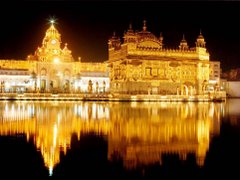
Vaisakhi falls during mid-April every year and was traditionally celebrated with the first harvesting of the crops for the year. Vaisakhi is not a New Year for the Sikhs. The Sikh New Year is celebrated on the 1st day of �Chet� which usually falls on March 13, a month eariler. For many years before 1699 this day was used by Guru Sahiban to spread their message to people who would gather from all over the country. There would be fairs organised and people would come from far to buy and sell different items. The main congregation would happen at Anandpur Sahib.
On April 13th, 1699 Guru Gobind Rai created the order of Khalsa by �initiating� five people by giving them �khandeh bateh da amrit� or nectar and then partook the amrit from these five to be himself initiated. Since that day Vaisakhi is celebrated all over the world as the birthday of the Khalsa.
As history has it, The Mughal Emperor, Aurangzeb, embarked on a policy of religious persecution and set upon the process of Islamization of India. The Brahmins were his primary target as he levied unethical religious taxes and shut their temples and places of learning based on suggestions that once the Brahmins converted others would follow. The Brahmins, particularly the inhabitants of Kashmir, looked for some dynamic leadership to fight this subversion and approached Guru Tegh Bahadur, the ninth in the line of Sikh Gurus for guidance on combatting the atrocities committed by the Aurangzeb. Gobind Rai, who was sitting beside him and asked him the reason of his contemplation and repose at the proposition of the Pundits. Guru Tegh Bahadur said that world is aggrieved by oppression; and a brave and selfless person is needed to come forward and sacrifice his life to free mankind from the burden of' Aurangzeb's persecution. Gobind Rai replied: "For that purpose who is more worthy than thou who art at once generous and brave." So after entrusting the Guruship to Gobind Rai, Guru Tegh Bahadur proceeded towards Delhi where he was arrested and later martyred by Aurangzeb after torturing him and his companions.
Guru Teg Bahadur offered his life for the freedom to practise religion as per ones conscience and conviction. He gave his life to save the "janeu" that Guru Nanak had refused to wear. It was a principled stand. One offering to wear it only if it offered him freedom from his vices (as Nanak says in Raag Asa: Let mercy be the cotton, contentment the thread, Continence the knot and truth the twist. Oh priest! if you have such a thread, Do give it to me. It will not wear out, nor get soiled, nor be burnt, nor lost. Says Nanak, blessed are those who go about wearing such a thread) and the other giving his life to protect it for it stood as a symbol of the religious freedom of those wearing it.
The spirit of sacrifice and courage that Guru Tegh Bahadur had was carried on by Gobind Rai who in 1699, months before Baisakhi Day, sent special edicts to congregation far and wide that that year the Baisakhi was going to be a unique affair. He asked them not to cut any of their hair � to come with unshorn hair under their turbans and chunis, and for the men to come with full beards.
On Vaisakhi Day, in 1699, hundreds of thousands of people gathered around his divine temporal seat at Anandpur Sahib. The Guru addressed the congregants after his inspirational discourse, flashed his unsheathed sword and said that every great deed was preceded by equally great sacrifice: He demanded one head for oblation. After some hesitation one person offered himself. The Guru took him inside a tent. A little later he reappeared with his sword dripping with blood, and asked for another head. One by one four more earnest devotees offered their heads. Every time the Guru took a person inside the tent, he came out with a bloodied sword in his hand. Then the Guru emerged with all five men dressed piously in white. He �initiated� (baptised) the five in a new and unique ceremony called pahul, what Sikhs today know as the baptism ceremony. The Guru asked those five baptised Sikhs to baptise him as well. He then proclaimed that the Panj Pyare - the Five Beloved Ones -- would be the embodiment of the Guru himself: "Where there are Panj Pyare, there am I. When the Five meet, they are the holiest of the holy."This is symbolic of one surrendering himself completely to his Guru/God only then can one be reformed. At the same time the Guru gave his new Khalsa a unique, indisputable, and distinct identity. The Guru gave the gift of bana, the distinctive Sikh clothing and headwear. He also offered five emblems of purity and courage known as Five Ks: Kesh, unshorn hair; Kangha, the wooden comb; Karra, the iron (or steel) bracelet; Kirpan, the sword; and Kachera, the underwear.
Through this new transformation, no Sikh could ever hide behind cowardice. Political tyranny was not the only circumstance that was denigrating the society but a division of the society on the basis of caste caused a sense of degradation among the people and the Guru wanted to eliminate the caste system and its social ramifications in tune to the house of Guru Nanak's message all along. The constitution of the Panj Pyare is a true testimony of his desire to do away with social prejudices based on caste and creed as he amalgamated high and low castes into one. Among the original Panj Pyare, there was one Khatri, shopkeeper; one Jat, farmer; one Chhimba, calico printer/tailor; one Ghumar, water-carrier; and one Nai, a barber. The Guru gave the surname of Singh (Lion) to every Sikh and also took the name for himself. From Guru Gobind Rai he became Guru Gobind Singh. He also pronounced that all Sikh women embody royalty, and gave them the surname Kaur (Princess). With the distinct Khalsa identity and consciousness of purity Guru Gobind Singh gave all Sikhs the opportunity to live lives of courage, sacrifice, and equality fihgting injustice in all walks of life.
Vaisakhi celebrations at the Winnipeg South Sikh Center would start with the rendering of �Akhand Path�, which would begin on April 11th, 2008 and completion would occur on April 13th, 2008 followed by changing of the �Nishan sahib�. This would be followed by a kirtan darbar and presentations by children on the significance of the day. Guru Ka Langar would be served on all three days. People from all walks of life and faith are invited to join the sikh population of winnipeg in celebration of the birthday of the Khalsa.
vYswKu Blw swKw vys kry ]Dn dyKY hir duAwir Awvhu dieAw kry ]Gir Awau ipAwry duqr qwry quDu ibnu AFu n molo ]kImiq kaux kry quDu BwvW dyiK idKwvY Folo ]dUir n jwnw AMqir mwnw hir kw mhlu pCwnw ]nwnk vYswKIN pRBu pwvY suriq sbid mnu mwnw ]6]
vaisaakh bhalaa saakhaa vaes karae dhhan dhaekhai har dhuaar aavahu dhaeiaa karae ghar aao piaarae dhuthar thaarae thudhh bin adt n molo keemath koun karae thudhh bhaavaa(n) dhaekh dhikhaavai dtolo dhoor n jaanaa a(n)thar maanaa har kaa mehal pashhaanaa naanak vaisaakhee(n) prabh paavai surath sabadh man maanaa 6Baisakhi is so pleasant; the branches blossom with new leaves.The soul-bride yearns to see the Lord at her door. Come, O Lord, and take pity on me!Please come home, O my Beloved; carry me across the treacherous world-ocean. Without You, I am not worth even a shell.Who can estimate my worth, if I am pleasing to You? I see You, and inspire others to see You, O my Love.I know that You are not far away; I believe that You are deep within me, and I realize Your Presence.O Nanak, finding God in Baisakhi, the consciousness is filled with the Word of the Shabad, and the mind comes to believe. 6