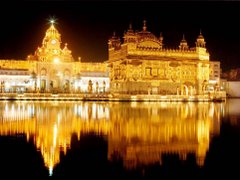
Every time a non-Sikh wishes to learn more about Sikhs, invariably the words seva, equality of women fumble out as a hallmark of Sikhi. For many years I have introduced Sikhs to my friends, colleagues and strangers on planes, trains and roads as those devoted to service of humanity. Every time I would do so, the ape in me would thump his chest and feel pride in giving equality to women and helping those who are less fortunate. The ape took a harsh beating recently. Allowing women to do various types of seva including kirtan at the Harimandir Sahib has been in the news for some time now. Some digging took me to this article by Kirn Kaur written almost 15 years back. The ape realized one thing for sure that without humility true seva is not possible, which made me wonder at the nature of seva some of these men do at the Harimandir. The article is reproduced as such and the link below is to the picture she made.
By Guru Kirn Kaur Khalsa
We were expectant and excited as we started down to the Siri
Harimandir Sahib at 12:10 AM on March 10th, 1996. This was the night
for which I had prayed for years. Tonight we would be graced with the
blessing of doing seva in our Guru's House in the Amrit Vela. Bibiji
Inderjit Kaur, wife of Siri Singh Sahib Harbhajan Singh Khalsa
Yogiji, myself and several other ladies had traveled from America on
Singh Sahib Manjit Singh's invitation to participate in the long
awaited opportunity to participate in this holy seva. Together, we
walked around the parkarma and made our way in silence to the
Darshani Deori. We sat down with the other Gursikhs who had gathered
there for seva. Soon we were joined by Bibi Amarjit Kaur, Shaheed
Bhai Fauja Singhji, and other ladies from Amritsar. We meditated and
read our banis in humble preparation of this blessed Amrit Vela.
Soon most of the men who had been sitting stood and moved away,
joining a crowd which had formed by the Nishan Sahib. We stood up to
see what was happening, and though we sensed hostility we were felt
assured because Singh Sahib Manjit Singh, the Jethadar of the Akal
Takhat Sahib, was there speaking to the men. Within minutes, the
voices became loud and angry. Suddenly the crowd began to move and
swept over to us. We were surrounded and engulfed by a crowd with
angry faces and loud voices. The mob argued and screamed at Singh
Sahibji and our group of ladies. With pointing fingers and hostile
voices they opposed us. Bibi Amarjit Kaur and Bibi Inderjit Kaur, the
warriors that they are, held their ground and spoke back with clear
words. In anger and frustration, the men pressed against us, trying
to push us back. The ladies grabbed onto each other and we firmly
held our ground. One of the younger women started crying, and I put
my arms around her to comfort her. The men screamed at the top of
their lungs and beat their chests yelling "Bole so Nihal" and "Deg
Teg Fateh", as if it were theirs and not ours. We yelled the battle
cry along with them, as loudly as they did.
Singh Sahibji motioned to a group of men, moving them away from us
over to the small office to the left of the main doors. The group
moved with him, but maintained its anger and intensity. It seemed he
stood alone against the crowd, and we feared for his safety. Still,
he stood his ground and kept up the dialog.
With the crowd away from doors, we were left in somewhat quiet and we
sat down to wait. A Gursikh resumed the Sukhmani Sahib which brought
some peace to the morning air. But the crowd's mood remain unchanged.
With a sense of triumph, men from the knot of people around the
Jethadar made their way to the small gate in the door and went
through to begin cleaning the floors of Harimandir Sahib. In
meditation, we sat and waited.
At about 1:20 AM, Singh Sahibji appeared at the door, motioning to us
and said in hushed voice, "Come!" We walked down the long causeway,
our breath short and anxious. It was the prayer of a lifetime with
each step. We came to the door, and bowed our heads low and grateful,
and then stood to one side. We waited for a sign of what to do, but
we were completed avoided and ignored. Most of the work was already
done anyway. Singh Sahibji motioned for us to go outside, and do
whatever cleaning needed to be done. There were brooms, and several
kind Gursikhs gave of cloths and showed us to wipe the brass and marble.
We put our whole hearts into that cleaning, wiping, and polishing
with utmost devotion. Tears blurred our sight, and emotion shook in
our hands. I looked up at the clock tower, and saw that it was 1:30
AM. I wondered when it was that a woman last had that same view at
that time in the Amrit Vela. I wondered when I would have that blessing again?
A little after 2:00 AM the seva was completed and we sat to the right
of the Manji Sahib. Soon, the traditional chanting began in
preparation for the opening of the gates, prasad was brought in, and
the morning routine continued. The sangat arrived at 2:45 AM. We
stayed to listen to the holy Asa Di Var, and then left through the
main gates which, by this time, were open to all.
The following night I returned to do evening seva at the Harimandir
Sahib. When this was completed and the doors were closed at 11 PM, I
sat outside the gates to the right of the line of men sitting and
waiting to wash the floors. I brought with me prints of the painting
I had made of the woman washing the floors and the poem "Pure
Longing" translated into Punjabi. I sat in silence and read Sukhmani
Sahib. One by one, the sevadars came over and took the prints until
they were all gone.
At 12:50 AM the line of men stood up to go in for seva, and I stood
up with them. But tonight, I had decided not to enter unless I was
invited. A tall man with a white beard spoke for the group in a
respectful voice, "Madam, it is ordered that women no wash the
floors". I nodded my head and continued to wait.
The men presented their passes and one by one they filed pasted the
sevadar at the gate. The sevadar was a tall, young man and he very
carefully and thorough questioned several of the men. I recognized
them as key agitators from the previous night. One of these men was
not let in, and he argued fiercely. His right to seva had been
revoked because of his actions. Finally, they were all in, the door
was closed and we sat to begin Sukhmani Sahib.
As I turned to leave, I was stopped by an old woman. She smiled at me
and asked for one of the prints, as did many other people that I
encountered on my way around the parkarma. I had accomplished what I
had set out to do: to repeat the prayer, in a quiet way by my
presence, for the women to wash the floors of Harimandir Sahib. Time
will do the rest.
http://www.gurukirn.com/Pure%20Longing.htm
Friday, February 4, 2011


Wednesday, April 7, 2010
Bhai Sahib Nirmal Singh Ji Khalsa
One small step for man and a giant leap for mankind is how Neil Armstrong had summed up his first step on the surface of moon about four decades ago. This week, the sangat at Winnipeg was joined by Bhai Nirmal Singh ji Khalsa, Hazoori raagi Sri Darbar Sahib, Amritsar for a week long recitation of kirtan. Winnipeg, as we all know, is fortunate to have excellent proponents of kirtan doing service at the local gurdwaras. But sangat has always missed the opportunity to hear great classical kirtan singers who would normally visit Vancouver or Toronto for a short trip. Ironically, the East Indian population in Winnipeg does not miss an opportunity to invite/host film singers, gazhal singers, actors and even comics but had not warmed up to the concept of inviting renowned kirtan jathas to the city.
First two days of the diwaan, and there was no place to sit as we had capacity turnouts to hear Bhai sahib recite bani. One always wonders at the great wisdom of the Guru Sahiban who composed Guru Granth Sahib and wrote the shabads in ragaas (31; although raagmala has many more listed but we would not go there). Singing of the hymns makes it such a lovely experience and if you have one of the great classical proponents reciting the hymns, it only adds to the flavor.
As we move on, it is hoped the sangat would support this endeavour and we are able to bring more revered kirtan singers to the city in future.
First two days of the diwaan, and there was no place to sit as we had capacity turnouts to hear Bhai sahib recite bani. One always wonders at the great wisdom of the Guru Sahiban who composed Guru Granth Sahib and wrote the shabads in ragaas (31; although raagmala has many more listed but we would not go there). Singing of the hymns makes it such a lovely experience and if you have one of the great classical proponents reciting the hymns, it only adds to the flavor.
As we move on, it is hoped the sangat would support this endeavour and we are able to bring more revered kirtan singers to the city in future.
Saturday, March 13, 2010
Should the Sikhs Eat Meat?
I won’t tell you my age but hardly a day of my Earthly existence has passed without hearing a passionate discussion on eating meat. Inadvertently, the day belongs to the group that can score a home run with their logic. I have seen debates on jhutka and halaal. I have seen debates on horse meat and milch animals. The argument never seems to end. Some quote the Dasam Granth while others the lack of any such reference in the Aad Guru Granth Sahib (AGGS). Occasionally, I get drawn into such discussions but only when I know the tempers of people involved.
Recently, I had a chance to watch the rather barbaric movie, “The Cove’. As you all know, it describes vividly (leaving nothing much to your imagination) how dolphins are massacred to serve the palate of a few. And I thought SAW was the only barbaric movie I had ever seen. Let us not go off topic here. I also watched some clippings on YouTube of how different animals raised for meat are treated. Chicken, cow, veal, pig, ducks all sorts of them. All these years we thought that these animals were injected with hormones to mature them faster and increase their muscle mass. Now it seems a new wave of animal raising has arrived. These animals are force fed. So a long feeding tube is shoved through the mouth right into the stomach of the animal and feed is pushed down. This forced feeding, irrespective of whether the animals wishes to eat or not, makes the animal grow faster. The animals are cramped together and occasionally restricted on purpose from moving around. This reduces the amount of calories they burn and hence all the food they consume is converted into fat/muscle. The condition of these animals is unimaginable. Normally, their weight crushes their legs and they become sedentary anyways.
This made me revisit the Sikh philosophy of Jhutka. As suggested by many (I have no clue where the concept of jhutka came from), the basic purpose of jhutka is to save the animal from pain and suffering and hence our avoidance of Halaal. With all the barbarism that goes into raising animals for meat, where does it leave our concept of jhutka? After all what we consume is either processed meat or cleaned meat sold at grocery stores. We gave ‘The Cove’ an Oscar as it suits our sensibilities but we continue to consume the force fed animal meat. We continue to entertain ourselves by forcing dolphins to dance to our tunes as this torture is not against our sensibility. Bhagat Kabeer ji says, “pati tore malini, pati pati jeeyoh, jis pahan ko pati tore so pahan nirjio”. The flower girl worships a stone idol by offering flowers. Little does she realize that every single petal of the flower is alive with life but the idol she tries to please by offering those petals is non-living. He further says, "brahm pati bisn dari fuul shankar dhaeo, teen dev prtakh toreh kareh kis kii saeo". Brahma is in the leaves, Vishnu is in the branches and Shiva is in the flowers. When you break all these three Gods, who are you serving? "Pakhan gadd ke murat kini deh keh chatti pav, je eh murat sachi heh tu garranhareh khau". The sculptor carves the stone to make an idol by keeping his feet on the stone. If this stone was God indeed, HE would devour the sculptor for disrespect.
Every single day we waste our energies on countless rituals of jhutka, halaal, kosher etc never pausing once to reflect if our actions are indeed pleasing the lord almighty we claim to serve. We do not hesitate to reference Guru Gobind Singh ji in our discussions on consumption of meat but forget the steel bracelets he blessed us with, Reminders of our being slaves of the creator. We only serve our palates and in a larger perspective, our vested menial personal interests, of which we have become slaves.
Recently, I had a chance to watch the rather barbaric movie, “The Cove’. As you all know, it describes vividly (leaving nothing much to your imagination) how dolphins are massacred to serve the palate of a few. And I thought SAW was the only barbaric movie I had ever seen. Let us not go off topic here. I also watched some clippings on YouTube of how different animals raised for meat are treated. Chicken, cow, veal, pig, ducks all sorts of them. All these years we thought that these animals were injected with hormones to mature them faster and increase their muscle mass. Now it seems a new wave of animal raising has arrived. These animals are force fed. So a long feeding tube is shoved through the mouth right into the stomach of the animal and feed is pushed down. This forced feeding, irrespective of whether the animals wishes to eat or not, makes the animal grow faster. The animals are cramped together and occasionally restricted on purpose from moving around. This reduces the amount of calories they burn and hence all the food they consume is converted into fat/muscle. The condition of these animals is unimaginable. Normally, their weight crushes their legs and they become sedentary anyways.
This made me revisit the Sikh philosophy of Jhutka. As suggested by many (I have no clue where the concept of jhutka came from), the basic purpose of jhutka is to save the animal from pain and suffering and hence our avoidance of Halaal. With all the barbarism that goes into raising animals for meat, where does it leave our concept of jhutka? After all what we consume is either processed meat or cleaned meat sold at grocery stores. We gave ‘The Cove’ an Oscar as it suits our sensibilities but we continue to consume the force fed animal meat. We continue to entertain ourselves by forcing dolphins to dance to our tunes as this torture is not against our sensibility. Bhagat Kabeer ji says, “pati tore malini, pati pati jeeyoh, jis pahan ko pati tore so pahan nirjio”. The flower girl worships a stone idol by offering flowers. Little does she realize that every single petal of the flower is alive with life but the idol she tries to please by offering those petals is non-living. He further says, "brahm pati bisn dari fuul shankar dhaeo, teen dev prtakh toreh kareh kis kii saeo". Brahma is in the leaves, Vishnu is in the branches and Shiva is in the flowers. When you break all these three Gods, who are you serving? "Pakhan gadd ke murat kini deh keh chatti pav, je eh murat sachi heh tu garranhareh khau". The sculptor carves the stone to make an idol by keeping his feet on the stone. If this stone was God indeed, HE would devour the sculptor for disrespect.
Every single day we waste our energies on countless rituals of jhutka, halaal, kosher etc never pausing once to reflect if our actions are indeed pleasing the lord almighty we claim to serve. We do not hesitate to reference Guru Gobind Singh ji in our discussions on consumption of meat but forget the steel bracelets he blessed us with, Reminders of our being slaves of the creator. We only serve our palates and in a larger perspective, our vested menial personal interests, of which we have become slaves.
Food and Sikhs
Every Sunday we visit the gurdwara, listen to the bani of our Guru Sahibaan, savor delicacies during langar (and pack some for home). Never do we wonder that one of the most important things that Gurbani emphasizes upon is avoiding things that corrupt the body and mind. Guru Nanak says, “baba hor khana khusi khawar, jit khadeh, tan peeriyeh, man meh chaleh vikaar”. Those foods that cause pain to the body and corrupt the mind should be avoided. He goes on to say the same for clothes and our rides too. So just as we reach out for that lovely looking gulab jamun, we should wonder that the Gurbani that we seek guidance from for all our spiritual needs, teaches us how to keep in shape too. Isn’t that great? To me that is a true personification of a living Guru. But how would I know that, if I don’t seek that information in the Aad Guru Granth Sahib? Well, we will discuss that some other time. So I decided that we need an expert to tell us about the health problems that our delicious food gives us.
A colleague/friend came over to the gurdwara and spoke about the effect of our dietary habits on our health. Yes, we are talking of our own Sikh community and all the jalebis and samosas we eat in snacks. We always top these up with food cooked in clarified butter with heavy masaala tarka. Our hospitality is incomplete if this is not followed by dessert of saweein or kheer or gulab jamuns. As the mouth savors all this, we overcome our guilt by consoling ourselves that we will soon burn all this on our fancy treadmills or through gym memberships. Fortunately for the treadmill and unfortunately for us, that day never arrives. The cholesterol in our diet, meanwhile, is busy lining our arteries and obstructing the smooth flow of blood to our heart, brain and other parts of the body. And when we find it hard to climb a flight of stairs, we conveniently take the elevator. Soon our vegetative existence forces us to see a doctor who after running some fancy tests on us declares that we have heart disease due to elevated cholesterol, triglycerides and what not. We start consuming loads of cholesterol reducing medicines hoping it would go away.
What we never realize is that we can do away with all this if we exercise regularly and decrease the serving size of our food. Needless to say, if we could steam instead of frying our food, it would do wonders. Ofcourse, we could have saved ourselves from all this if we had listened to our Guru in the first place. I chanced across this wonderful article from Dr. IJ Singh and thought of sharing with you. I would let him do rest of the talking and save some calories myself by not typing away.
Taboo or Not Taboo ... That is the Question ...by I.J. SINGH
The first response to the title of this essay is predictable: certainly there are no food taboos in Sikhism.
A colleague/friend came over to the gurdwara and spoke about the effect of our dietary habits on our health. Yes, we are talking of our own Sikh community and all the jalebis and samosas we eat in snacks. We always top these up with food cooked in clarified butter with heavy masaala tarka. Our hospitality is incomplete if this is not followed by dessert of saweein or kheer or gulab jamuns. As the mouth savors all this, we overcome our guilt by consoling ourselves that we will soon burn all this on our fancy treadmills or through gym memberships. Fortunately for the treadmill and unfortunately for us, that day never arrives. The cholesterol in our diet, meanwhile, is busy lining our arteries and obstructing the smooth flow of blood to our heart, brain and other parts of the body. And when we find it hard to climb a flight of stairs, we conveniently take the elevator. Soon our vegetative existence forces us to see a doctor who after running some fancy tests on us declares that we have heart disease due to elevated cholesterol, triglycerides and what not. We start consuming loads of cholesterol reducing medicines hoping it would go away.
What we never realize is that we can do away with all this if we exercise regularly and decrease the serving size of our food. Needless to say, if we could steam instead of frying our food, it would do wonders. Ofcourse, we could have saved ourselves from all this if we had listened to our Guru in the first place. I chanced across this wonderful article from Dr. IJ Singh and thought of sharing with you. I would let him do rest of the talking and save some calories myself by not typing away.
Taboo or Not Taboo ... That is the Question ...by I.J. SINGH
The first response to the title of this essay is predictable: certainly there are no food taboos in Sikhism.
This is after all a young, modern, vibrant faith, very practical in its doctrines and sensible in its beliefs. But there is always a hooker.
What set me thinking about food restrictions was something that happened about twenty-five years ago; I have heard periodic echoes of the issue over the years. For about three months, I was the Secretary of our major, and at that time the only, gurdwara in New York. We used to meet once a month, then it became once a week.
More regular in attendance than any others were some young, single Sikhs, mostly students, living in the city. I think what attracted them was the socializing and the free community lunch that always followed the service. I could relate to that and to them. Often we would spend half a Sunday at the gurdwara and then gather at someone's apartment to shoot the breeze and solve the problems of the world.
One day a group of young friends volunteered to provide the community lunch following the weekly service. Of course, they would not prepare a traditional meal but offered to serve ham and cheese sandwiches instead. I thought it was a great idea. When I broached the management committee however, all hell broke loose. How could I think of sandwiches, I was asked? I offered pizza but the reaction was not much better. I was told in no uncertain terms that the meal must be a simple Punjabi meal - vegetables, beans, unleavened flat bread (chappaties). Rice could be added or substituted for the bread, if necessary. Accompaniment of pickle and a good dessert would round up the menu. The preparations did not have to be simple and, depending upon the host, could be elaborate, but the menu was to be strictly vegetarian and under no circumstances was it to depart substantially from the traditional Punjabi meal.
I too adore Punjabi food and more so with each passing year that I live outside a Punjabi milieu. But I wonder at the unwritten code on food proscription that seems to operate at Sikh gatherings. Where in Sikh history or theology does it say that all meals are to be vegetarian or prepared in a particular way? And following religious services at homes I have partaken of community meals which were so extensive and elaborate that they would rival the spread at the fanciest restaurant.
Such a feast raises the obvious question: Is that what the Guru intended when he initiated the concept of a community meal (langar) following a religious service?
History provides us some sensible ways of looking at what we believe and what we actually do.
Indeed Sikhs observe no food taboos as are found among the Jews, Muslims or Hindus, among others. Of the two dominant religions in India, the Hindus eat no beef while the Muslims will not come near pork. The Sikhs find common ground by finding both kinds of flesh acceptable. It is true nevertheless, that a great majority of Sikhs do not eat beef since many of them come from a Hindu background. In fact in Punjab, before India was partitioned in 1947, neither beef nor pork was easily available in deference to the strong beliefs of the two majority religions. Also many if not most Hindus are obligatory vegetarians. Observing Jains eat no eggs or onions either.
Consequently, most Sikhs never acquired a taste for either beef or pork but are content with chicken, mutton or lamb. Landlocked Punjab does not have much of a variety in fish, but it is enjoyed in the limited quantity that it is available.
Throughout Sikh history, there have been movements or subsects of Sikhism which have espoused vegetarianism. I think there is no basis for such dogma or practice in Sikhism. Certainly Sikhs do not think that a vegetarian's achievements in spirituality are easier or higher. It is surprising to see that vegetarianism is such an important facet of Hindu practice in light of the fact that animal sacrifice was a significant and much valued Hindu Vedic ritual for ages.
Guru Nanak in his writings clearly rejected both sides of the arguments - on the virtues of vegetarianism or meat eating - as banal and so much nonsense. Nor did he accept the idea that a cow was somehow more sacred than a horse or a chicken. He also refused to be drawn into a contention on the differences between flesh and greens, for instance.
History tells us that to impart his message, Nanak cooked meat at an important Hindu festival in Kurukshetra. Having cooked it, he certainly did not waste it, but probably served it to his followers and ate himself. History is quite clear that Guru Hargobind and Guru Gobind Singh were accomplished and avid hunters. The game was cooked and put to good use, to throw it away would have been an awful waste.
Sikhs also do not respond to the Semitic commandment on avoiding animals with cloven hoofs. And one Semitic practice clearly rejected in the Sikh code of conduct is eating flesh of an animal cooked in a ritualistic manner; this would mean kosher and halal meat. The reason again does not lie in religious tenet but in the view that killing an animal with a prayer is not going to ennoble the flesh. No ritual, regardless of who conducts it, is going to do any good either to the animal or to the diner. Let man do what he must to assuage his hunger. If what he gets, he puts to good use and shares with the needy, then it is well used and well spent, otherwise not.
The community meal (langar) that the Sikhs serve in their gurdwaras has several purposes. Much of India even now is bound in traditions of caste. In the Hindu caste system, the high and the low castes do not mix socially, do not eat from the same kitchen. The food of a Brahmin is considered defiled if the shadow of an untouchable or a Muslim falls upon it.
Sikhism set out to break these barriers. In the gurdwara, the meal is served to people who sit in a row. You may not chose who to sit next to; it may even be an 'untouchable'. You may not ask to be served by someone special. The food is prepared by volunteers from the community in a community kitchen. Men, women and children, rich and poor alike, work together to cook and to serve.
This is also where young and old, children and adults, learn the concept of service. The food is available to all; kings and the homeless have partaken of it. Emperor Akbar who ruled India in the sixteenth century enjoyed such a meal. In this country, most gurdwaras do not have langar service operating all day but one that serves only one meal at the conclusion of a service. Therefore, whatever food is left over is either carted home by those who wish, or is delivered to a center for the needy.
In the sixties many hippies trekking through India found gurdwaras an easy place for a quick and free meal; countless homeless people enjoy this Sikh hospitality every day. It is a way for the ordinary Sikh to thank God from whom all blessings flow. Service to the needy and sharing one's blessings with others is a cornerstone of the Sikh way of life and it starts in the community kitchen. It is a recognition of the principle that even God has little meaning or relevance to an empty belly. The prayers of the congregation and their spirit of service make the meal special, not the variety in the menu.
The usual menu in a gurdwara is simple - one vegetable, some beans, a handful of rice and one or two pieces of flat bread (chappaties). This is what the poorest people in Punjab eat. The ingredients are what the simplest home in Punjab would have. Fancier dishes are avoided even if one can afford them for the purpose is not to instill envy in others or to show off one's own riches. If meat is avoided, it is not because of any canon but because the menu should be such that everybody can afford and anybody can eat; something nobody will have any compunctions or reservations about.
Remember that gurdwaras are open to all and often frequented by Hindus and Muslims alike. The menu for the langar at the gurdwara has to provide the least common denominator in the local cultural tradition.
I have heard there are a few, rare gurdwaras in India where meat is served at times. I emphasize that such gurdwaras are few and in them, service of meat is rare. I suppose the practice started sometime ago for certain historical reasons and has continued. No harm in it as long the people coming there are aware of it.
It is not a matter of Sikh doctrine but of consideration for others and common sense. Some historians contend that meat was often served in langar at the time of Guru Angad. History has it that Guru Amar Das, well before he became a Guru, visited Guru Angad. On that day, some Sikh had donated a large quantity of fish which was being served in the community meal. Amar Das had been a devout Hindu and a vegetarian until that time. Some historians say that he was somewhat squeamish about it but, now that he had become a Sikh, accepted the fish as a gift from the Guru's kitchen.
Others suggest that Guru Angad, knowing full well that Amar Das was a vegetarian, directed the sevadars not to offer him the fish. Considering the love of nature and of God's creation in the writings of the Gurus, wanton killing of animals would not be condoned, not would be their ritual sacrifice for gustatory satisfaction or otherwise.
There are other benefits to a simple but sufficient lunch after a service. The attendees know that they do not have to rush home and feed the kids or themselves. The mind is not distracted by the chores waiting at home; time off from them is a welcome respite, however brief. One can relax and enjoy the service single-mindedly.
Hindus have often debated if what you eat determines your spiritual status. Sikhs do not believe that. With such practical and liberal reasoning, some strange and unorthodox practices can also arise. Khushwant Singh speaks of a gurdwara in Australia which serves beer with the food. Given Sikh history and teaching, that just wouldn't do.
In his many writings, Guru Nanak offered only two criteria for food taboos, both are based on common sense. Anything that will harm the body or mind is to be shunned. And all things edible are available and permissible in moderation.
Over the years, I have seen many variations on the theme but to discuss and debate unnecessarily what to eat or not to eat in Sikhism is to transform what a modicum of intelligence and common sense can easily resolve into a mesh with the complexity of the Gordion knot.
Procrastination
So finally I get a chance to update my blog. I hate to admit my procrastination. But I guess the website takes most of my time. So lets see whats new.
Monday, November 10, 2008
Sikh Heroes of Flanders Field


As the world remembers its fallen heroes of ‘Ypres’ a recent discovery of a WWI Medal Reveals the Story of a Forgotten Sikh Canadian Hero and has once again highlighted the sacrifices Sikhs all over the world have made to uphold justice, equality and peace.
Visible minorities were not welcome into the Canadian army when war broke out in 1914. Canada joined the war the day after Britain declared war on Germany. When 50 blacks from Sydney, Nova Scotia volunteered their services they were told, "This is not for you fellows, this is a white man's war." By 1915 blacks, aboriginals, Japanese Canadians and other minorities were allowed to join the military, but mainly in segregated units. But interestingly, documentary evidence from different sources shows that Sikhs were integrated into mainstream Canadian battalions, which included Buckam Singh and eight other Sikh Canadian soldiers and were not placed into one of the existing segregated units.
The bravery of this Sikh, born on December 5, 1893 at Mahilpur in the Hoshiarpur district of Punjab, first came to light when he was reported in the list of injured for the day by ‘The Toronto Daily Star’ on August 9th, 1916. PTE Bukum Singh enlisted with the 59th Infantry Battalion of the Canadian Expeditionary Force in 1915. His father was Badan Singh Bains and his mother was Chandi Kaur. Canadian soldiers arrived in England in the September of 1915 and were put in reserve battalions till ready to see action in some part of Europe. Bukum Singh and his battalion were sent to France in January of 1916 and were transferred from the 39th Reserve Battalion to the 20th Battalion where he remained till the end of his part in the war.
Flanders is a region in Belgium and the principal town around which the fighting in Flanders revolved was Ypres, and the area around the town of Ypres was also known as the Salient. This sector saw some of the most gruesome action recorded in the history of any war. From October of 1914 till the end of the war in November 1918 trenches of Ypres swallowed many a brave human soul on either side.
Buckam Singh’s 20th Battalion was assigned to the 4th Brigade, and sent to the front on the Ypres Salient, near Messines. The winter of 1915-16 saw many a soldiers battling lice, trench foot, and disease besides the enemy. In March 1916, steel helmets were issued to all ranks. Pictures from the war front and documentary evidence points, though, to the fact that Sikhs fought the war in their turbans and many British generals make a noteworthy mention of this fact (see below). Bukum Singh’s 20th Battalion has been mentioned to have recaptured a sector in this region and held on to it through a month of concentrated shelling. The total loses of the 4th Brigade in that one month were 1373 casualties.
The Toronto Daily Star of Aug 9, 1916 reported: “PTE. BUKUM SINGH, the first Sikh to enlist with an Ontario battalion has been twice wounded since he went to the front. He was engaged as a farm hand for W. H. Moore, of Rosebank Ont., when the call came for active service. He was reported injured for the first time two months ago. His name appears among the wounded in to-day's list. Bukum Singh came to Canada from Punjab in 1907. After mining in British Columbia he came to Toronto about two years ago. He went overseas with a Kingston battalion.”
This was based on an interview by the Toronto Star of Bukum Singh in an army hospital in Manchester, England. While convalescing, he is reported to have developed a respiratory illness. He was treated by Dr. John McCrae during his sickness. Bukum Singh died on August 27, 1919 at age 25 was buried in a soldier’s grave at Mount Hope Cemetery in Kitchener where he rests to this day. His ‘Victory Medal’, commissioned in 1919 reads: 454819 PTE. B. A. SINGH 20 – CAN. INF. A ‘Memorial Cross’ (given to widows and mothers) was also awarded to Buckam Singh's wife Pritam Kaur and another to his mother Chandi Kaur (also received a ‘Memorial Plaque and Scroll’) to recognize their personal loss and sacrifice.
Canadian army was not the only army with Sikh regiments or soldiers in WWI. Sikhs fought in Europe in Belgium and France at Flanders/Ypres, La Bassee, St. Julien, Festubert besides Egypt, Palestine, Mesopotamia, and Gallipoli. At the beginning of the WWI Punjab accounted for 124,000 men in combat ranks as part of the British Army. Three years later, the number had reached a quarter of a million. The Sikhs numbered approximately 65,000 soldiers, or 26% of the Punjabi total, despite representing only 14% of the male population of Punjab of fighting age. Nearly 1,500 distinctions issued for gallantry were awarded to Punjabis, of which 700 went to Sikhs. Besides these distinctions and service medals the Sikhs were awarded many a Victoria Cross.
In the last two world wars 83,005 turban wearing Sikh soldiers were killed and 109,045 were wounded.
“They all died or were wounded for the freedom of Britain and the World and during shell fire, with no other protection but the turban, the symbol of their faith." General Sir Frank Messervy KCSI, KBE, CB, DSO.
During WWI Sikhs were decorated for their bravery with Victoria Cross 10, IOM 100, IDSM 231, DSO 35, MC 46, MM 51, DSM 10. As Sikhs celebrate the birth anniversary of the founder of Sikh faith, Guru Nanak, who gave world the message of universal brotherhood of man, equality and justice, Sikh men and women under Canadian, American, British, Swiss, Pakistani and Indian flags (and countless other) see combat in Iraq, Afghanistan and certain places in Africa, to uphold that universal message.
Sikh National Anthem
Grant me this boon, O Lord:
I may never be deterred from good deeds.
Without fear I enter the battlefield.
With complete resolve I bring victory.
My mind be trained to sing Your praises.
And when my time comes, bring me a valiant death on the battlefield.
By the Tenth Master Guru Gobind Singh (DG p.99)
Proudly support the RED POPPY.
Monday, October 27, 2008
300th Gurta Gurgaddi Diwas
300th Gurta Gurgaddi Diwas celebrations and Bandi chhorr diwas and diwali would be celebrated at the Winnipeg South Sikh Center on Scurfield this coming Tuesday, October 28th, 2008. Kirtan Darbar from 6-8 PM would be followed by Langar and fireworks for children.
All are invited to attend.
All are invited to attend.
Wednesday, October 15, 2008
Birthday Celebrations of Guru Ram Das
Sikhs all over the world celebrated the Birthday of the Fourth Guru, Ram Das Ji. A few facts about Guruji are given below.
(Gurmukhi: ਗੁਰੂ ਰਾਮ ਦਾਸ) (24 September 1534 - 1 September 1581) was the fourth of the Ten Gurus of Sikhism and became Guru on 30 August 1574 following in the footsteps of Guru Amar Das ji. The Guru original name was Bhai Jetha.
Before Guru Ji died, he nominated Guru Arjan Dev ji, who was his youngest son as the next Guru of the Sikhs.
- Birth Place: Chuna Mandi, Lahore, Punjab (Present day Pakistan)
- Father: Haridas Ji
- Mother: Mata Daya ji (also known as Anoop Davi)
- Wife: Mata Bhani Ji
- Daughters: None
- Sons: Baba Prithi Chand ji, Baba Mahan Dev Ji, Guru Arjan Dev Ji
- Became Guru at age 40 years and had life span of 47 years.
- Gurbani: The Guru contributed a total of 688 Shabads/hymns to the Sri Guru Granth Sahib.
The fourth Sikh Guru contributed the following to the people of the world:
- Author of Laava, the hymns of the Marriage Rites
- Designed the Golden Temple
- Planned & created the township of Ramdaspur (later Amritsar)
- Organisation Structure of Sikh Society
Hymn by Guru Ram Das – SGGS Page 305
Tuesday, April 8, 2008
Vaisakhi in Winnipeg
Vaisakhi falls during mid-April every year and was traditionally celebrated with the first harvesting of the crops for the year. Vaisakhi is not a New Year for the Sikhs. The Sikh New Year is celebrated on the 1st day of �Chet� which usually falls on March 13, a month eariler. For many years before 1699 this day was used by Guru Sahiban to spread their message to people who would gather from all over the country. There would be fairs organised and people would come from far to buy and sell different items. The main congregation would happen at Anandpur Sahib.
On April 13th, 1699 Guru Gobind Rai created the order of Khalsa by �initiating� five people by giving them �khandeh bateh da amrit� or nectar and then partook the amrit from these five to be himself initiated. Since that day Vaisakhi is celebrated all over the world as the birthday of the Khalsa.
As history has it, The Mughal Emperor, Aurangzeb, embarked on a policy of religious persecution and set upon the process of Islamization of India. The Brahmins were his primary target as he levied unethical religious taxes and shut their temples and places of learning based on suggestions that once the Brahmins converted others would follow. The Brahmins, particularly the inhabitants of Kashmir, looked for some dynamic leadership to fight this subversion and approached Guru Tegh Bahadur, the ninth in the line of Sikh Gurus for guidance on combatting the atrocities committed by the Aurangzeb. Gobind Rai, who was sitting beside him and asked him the reason of his contemplation and repose at the proposition of the Pundits. Guru Tegh Bahadur said that world is aggrieved by oppression; and a brave and selfless person is needed to come forward and sacrifice his life to free mankind from the burden of' Aurangzeb's persecution. Gobind Rai replied: "For that purpose who is more worthy than thou who art at once generous and brave." So after entrusting the Guruship to Gobind Rai, Guru Tegh Bahadur proceeded towards Delhi where he was arrested and later martyred by Aurangzeb after torturing him and his companions.
Guru Teg Bahadur offered his life for the freedom to practise religion as per ones conscience and conviction. He gave his life to save the "janeu" that Guru Nanak had refused to wear. It was a principled stand. One offering to wear it only if it offered him freedom from his vices (as Nanak says in Raag Asa: Let mercy be the cotton, contentment the thread, Continence the knot and truth the twist. Oh priest! if you have such a thread, Do give it to me. It will not wear out, nor get soiled, nor be burnt, nor lost. Says Nanak, blessed are those who go about wearing such a thread) and the other giving his life to protect it for it stood as a symbol of the religious freedom of those wearing it.
The spirit of sacrifice and courage that Guru Tegh Bahadur had was carried on by Gobind Rai who in 1699, months before Baisakhi Day, sent special edicts to congregation far and wide that that year the Baisakhi was going to be a unique affair. He asked them not to cut any of their hair � to come with unshorn hair under their turbans and chunis, and for the men to come with full beards.
On Vaisakhi Day, in 1699, hundreds of thousands of people gathered around his divine temporal seat at Anandpur Sahib. The Guru addressed the congregants after his inspirational discourse, flashed his unsheathed sword and said that every great deed was preceded by equally great sacrifice: He demanded one head for oblation. After some hesitation one person offered himself. The Guru took him inside a tent. A little later he reappeared with his sword dripping with blood, and asked for another head. One by one four more earnest devotees offered their heads. Every time the Guru took a person inside the tent, he came out with a bloodied sword in his hand. Then the Guru emerged with all five men dressed piously in white. He �initiated� (baptised) the five in a new and unique ceremony called pahul, what Sikhs today know as the baptism ceremony. The Guru asked those five baptised Sikhs to baptise him as well. He then proclaimed that the Panj Pyare - the Five Beloved Ones -- would be the embodiment of the Guru himself: "Where there are Panj Pyare, there am I. When the Five meet, they are the holiest of the holy."This is symbolic of one surrendering himself completely to his Guru/God only then can one be reformed. At the same time the Guru gave his new Khalsa a unique, indisputable, and distinct identity. The Guru gave the gift of bana, the distinctive Sikh clothing and headwear. He also offered five emblems of purity and courage known as Five Ks: Kesh, unshorn hair; Kangha, the wooden comb; Karra, the iron (or steel) bracelet; Kirpan, the sword; and Kachera, the underwear.
Through this new transformation, no Sikh could ever hide behind cowardice. Political tyranny was not the only circumstance that was denigrating the society but a division of the society on the basis of caste caused a sense of degradation among the people and the Guru wanted to eliminate the caste system and its social ramifications in tune to the house of Guru Nanak's message all along. The constitution of the Panj Pyare is a true testimony of his desire to do away with social prejudices based on caste and creed as he amalgamated high and low castes into one. Among the original Panj Pyare, there was one Khatri, shopkeeper; one Jat, farmer; one Chhimba, calico printer/tailor; one Ghumar, water-carrier; and one Nai, a barber. The Guru gave the surname of Singh (Lion) to every Sikh and also took the name for himself. From Guru Gobind Rai he became Guru Gobind Singh. He also pronounced that all Sikh women embody royalty, and gave them the surname Kaur (Princess). With the distinct Khalsa identity and consciousness of purity Guru Gobind Singh gave all Sikhs the opportunity to live lives of courage, sacrifice, and equality fihgting injustice in all walks of life.
Vaisakhi celebrations at the Winnipeg South Sikh Center would start with the rendering of �Akhand Path�, which would begin on April 11th, 2008 and completion would occur on April 13th, 2008 followed by changing of the �Nishan sahib�. This would be followed by a kirtan darbar and presentations by children on the significance of the day. Guru Ka Langar would be served on all three days. People from all walks of life and faith are invited to join the sikh population of winnipeg in celebration of the birthday of the Khalsa.
vYswKu Blw swKw vys kry ]Dn dyKY hir duAwir Awvhu dieAw kry ]Gir Awau ipAwry duqr qwry quDu ibnu AFu n molo ]kImiq kaux kry quDu BwvW dyiK idKwvY Folo ]dUir n jwnw AMqir mwnw hir kw mhlu pCwnw ]nwnk vYswKIN pRBu pwvY suriq sbid mnu mwnw ]6]
vaisaakh bhalaa saakhaa vaes karae dhhan dhaekhai har dhuaar aavahu dhaeiaa karae ghar aao piaarae dhuthar thaarae thudhh bin adt n molo keemath koun karae thudhh bhaavaa(n) dhaekh dhikhaavai dtolo dhoor n jaanaa a(n)thar maanaa har kaa mehal pashhaanaa naanak vaisaakhee(n) prabh paavai surath sabadh man maanaa 6Baisakhi is so pleasant; the branches blossom with new leaves.The soul-bride yearns to see the Lord at her door. Come, O Lord, and take pity on me!Please come home, O my Beloved; carry me across the treacherous world-ocean. Without You, I am not worth even a shell.Who can estimate my worth, if I am pleasing to You? I see You, and inspire others to see You, O my Love.I know that You are not far away; I believe that You are deep within me, and I realize Your Presence.O Nanak, finding God in Baisakhi, the consciousness is filled with the Word of the Shabad, and the mind comes to believe. 6
On April 13th, 1699 Guru Gobind Rai created the order of Khalsa by �initiating� five people by giving them �khandeh bateh da amrit� or nectar and then partook the amrit from these five to be himself initiated. Since that day Vaisakhi is celebrated all over the world as the birthday of the Khalsa.
As history has it, The Mughal Emperor, Aurangzeb, embarked on a policy of religious persecution and set upon the process of Islamization of India. The Brahmins were his primary target as he levied unethical religious taxes and shut their temples and places of learning based on suggestions that once the Brahmins converted others would follow. The Brahmins, particularly the inhabitants of Kashmir, looked for some dynamic leadership to fight this subversion and approached Guru Tegh Bahadur, the ninth in the line of Sikh Gurus for guidance on combatting the atrocities committed by the Aurangzeb. Gobind Rai, who was sitting beside him and asked him the reason of his contemplation and repose at the proposition of the Pundits. Guru Tegh Bahadur said that world is aggrieved by oppression; and a brave and selfless person is needed to come forward and sacrifice his life to free mankind from the burden of' Aurangzeb's persecution. Gobind Rai replied: "For that purpose who is more worthy than thou who art at once generous and brave." So after entrusting the Guruship to Gobind Rai, Guru Tegh Bahadur proceeded towards Delhi where he was arrested and later martyred by Aurangzeb after torturing him and his companions.
Guru Teg Bahadur offered his life for the freedom to practise religion as per ones conscience and conviction. He gave his life to save the "janeu" that Guru Nanak had refused to wear. It was a principled stand. One offering to wear it only if it offered him freedom from his vices (as Nanak says in Raag Asa: Let mercy be the cotton, contentment the thread, Continence the knot and truth the twist. Oh priest! if you have such a thread, Do give it to me. It will not wear out, nor get soiled, nor be burnt, nor lost. Says Nanak, blessed are those who go about wearing such a thread) and the other giving his life to protect it for it stood as a symbol of the religious freedom of those wearing it.
The spirit of sacrifice and courage that Guru Tegh Bahadur had was carried on by Gobind Rai who in 1699, months before Baisakhi Day, sent special edicts to congregation far and wide that that year the Baisakhi was going to be a unique affair. He asked them not to cut any of their hair � to come with unshorn hair under their turbans and chunis, and for the men to come with full beards.
On Vaisakhi Day, in 1699, hundreds of thousands of people gathered around his divine temporal seat at Anandpur Sahib. The Guru addressed the congregants after his inspirational discourse, flashed his unsheathed sword and said that every great deed was preceded by equally great sacrifice: He demanded one head for oblation. After some hesitation one person offered himself. The Guru took him inside a tent. A little later he reappeared with his sword dripping with blood, and asked for another head. One by one four more earnest devotees offered their heads. Every time the Guru took a person inside the tent, he came out with a bloodied sword in his hand. Then the Guru emerged with all five men dressed piously in white. He �initiated� (baptised) the five in a new and unique ceremony called pahul, what Sikhs today know as the baptism ceremony. The Guru asked those five baptised Sikhs to baptise him as well. He then proclaimed that the Panj Pyare - the Five Beloved Ones -- would be the embodiment of the Guru himself: "Where there are Panj Pyare, there am I. When the Five meet, they are the holiest of the holy."This is symbolic of one surrendering himself completely to his Guru/God only then can one be reformed. At the same time the Guru gave his new Khalsa a unique, indisputable, and distinct identity. The Guru gave the gift of bana, the distinctive Sikh clothing and headwear. He also offered five emblems of purity and courage known as Five Ks: Kesh, unshorn hair; Kangha, the wooden comb; Karra, the iron (or steel) bracelet; Kirpan, the sword; and Kachera, the underwear.
Through this new transformation, no Sikh could ever hide behind cowardice. Political tyranny was not the only circumstance that was denigrating the society but a division of the society on the basis of caste caused a sense of degradation among the people and the Guru wanted to eliminate the caste system and its social ramifications in tune to the house of Guru Nanak's message all along. The constitution of the Panj Pyare is a true testimony of his desire to do away with social prejudices based on caste and creed as he amalgamated high and low castes into one. Among the original Panj Pyare, there was one Khatri, shopkeeper; one Jat, farmer; one Chhimba, calico printer/tailor; one Ghumar, water-carrier; and one Nai, a barber. The Guru gave the surname of Singh (Lion) to every Sikh and also took the name for himself. From Guru Gobind Rai he became Guru Gobind Singh. He also pronounced that all Sikh women embody royalty, and gave them the surname Kaur (Princess). With the distinct Khalsa identity and consciousness of purity Guru Gobind Singh gave all Sikhs the opportunity to live lives of courage, sacrifice, and equality fihgting injustice in all walks of life.
Vaisakhi celebrations at the Winnipeg South Sikh Center would start with the rendering of �Akhand Path�, which would begin on April 11th, 2008 and completion would occur on April 13th, 2008 followed by changing of the �Nishan sahib�. This would be followed by a kirtan darbar and presentations by children on the significance of the day. Guru Ka Langar would be served on all three days. People from all walks of life and faith are invited to join the sikh population of winnipeg in celebration of the birthday of the Khalsa.
vYswKu Blw swKw vys kry ]Dn dyKY hir duAwir Awvhu dieAw kry ]Gir Awau ipAwry duqr qwry quDu ibnu AFu n molo ]kImiq kaux kry quDu BwvW dyiK idKwvY Folo ]dUir n jwnw AMqir mwnw hir kw mhlu pCwnw ]nwnk vYswKIN pRBu pwvY suriq sbid mnu mwnw ]6]
vaisaakh bhalaa saakhaa vaes karae dhhan dhaekhai har dhuaar aavahu dhaeiaa karae ghar aao piaarae dhuthar thaarae thudhh bin adt n molo keemath koun karae thudhh bhaavaa(n) dhaekh dhikhaavai dtolo dhoor n jaanaa a(n)thar maanaa har kaa mehal pashhaanaa naanak vaisaakhee(n) prabh paavai surath sabadh man maanaa 6Baisakhi is so pleasant; the branches blossom with new leaves.The soul-bride yearns to see the Lord at her door. Come, O Lord, and take pity on me!Please come home, O my Beloved; carry me across the treacherous world-ocean. Without You, I am not worth even a shell.Who can estimate my worth, if I am pleasing to You? I see You, and inspire others to see You, O my Love.I know that You are not far away; I believe that You are deep within me, and I realize Your Presence.O Nanak, finding God in Baisakhi, the consciousness is filled with the Word of the Shabad, and the mind comes to believe. 6
Sukhmani Sahib Path on every Thursday at Sikh Center Gurdwara
Sukhmani (sukhan di mani; consoler of mind; Psalm of Peace) Sahib, composed by Sahib Sri Guru Arjan Dev ji, the fifth guru in Raag Gauri consists of 24 ashtpadis starting on page 262 of the Aad Sri Guru Granth Sahib to page 296. Each ashtpadi begins with a shalok followed by eight pauris (stanzas) and each pauri has ten lines in five couplets. Many people believe that just like Japuji sahib, sukhmani sahib also summarizes the essence of Aad Guru Granth Sahib and where it speaks of the almighty in an elequont manner it also sums up the basic teachings of Sikh faith. Like the other compositions/banis, this beautiful composition is recited daily by many people who have faith in other religions besides the Sikhs. This beautiful composition embodies the message of Sikh Gurus, as enshrined in Aad Sri Guru Granth Sahib ji, of universal brotherhood of man rising above all vices and inequalities to be one with God. Its central message revolves around the fact that in order to be one with God one has to be at peace with himself and the environment and other human beings. Sukhmani Sahib urges one to recite the name of 'Akal Purakh', the eternal being, and remember him at all times. It teaches that by practising holiness, ones tendency to sin decreases. Practise of noble deeds and meditation provides for being one with the creator. Individually or in chorus, this bani like many other compositions from Aad Guru Granth Sahib, is recited by people of all faiths besides Sikhs on a daily basis.
The executive at Winnipeg South Sikh Center Gurdwara feels immense pleasure in implementing the suggestion of the congregation/sangat to start recitation of Sukhmani Sahib path every Thursday at The Winnipeg South Sikh Center Gurdwara. Sukhmani sahib path recitation would start at 6.30PM sharp and would be followed by Rehraas Sahib path and ardas followed by langar. The sangat is requested to join at the gurdwara on Thursdays at 6.30PM and benefit from this ethereal experience.
People from all other communities are welcome to be a part of the congregation.
The executive at Winnipeg South Sikh Center Gurdwara feels immense pleasure in implementing the suggestion of the congregation/sangat to start recitation of Sukhmani Sahib path every Thursday at The Winnipeg South Sikh Center Gurdwara. Sukhmani sahib path recitation would start at 6.30PM sharp and would be followed by Rehraas Sahib path and ardas followed by langar. The sangat is requested to join at the gurdwara on Thursdays at 6.30PM and benefit from this ethereal experience.
People from all other communities are welcome to be a part of the congregation.
Wednesday, February 27, 2008
Gurdwara website
Dear All
The gurdwara has a new website. For all information related to gurdwara activities, upcoming events including gurpurabs, akhand paths, punjabi class and for booking of akhand paths or Langar seva please visit the above website.
Waheguru Ji Ka Khalsa
Waheguru Ji Ki Fateh
The gurdwara has a new website. For all information related to gurdwara activities, upcoming events including gurpurabs, akhand paths, punjabi class and for booking of akhand paths or Langar seva please visit the above website.
Waheguru Ji Ka Khalsa
Waheguru Ji Ki Fateh
Monday, November 5, 2007
Diwali Celebrations at the Gurdwara
Guru Pyaree sadsangat ji
Waheguru Ji Ka Khalsa Waheguru Ji ki Fateh!!!
Diwali is a festival of lights that reminds us of the victory of good over evil. It is a time to do some introspection and pump up our inner self and enlighten it to the good it is destined to do. Sikhs all across the globe celebrate the occasion to mark the victorious homecoming of sahib Sri Guru Hargobind sahib from Gwalior after successfully securing the release of 52 kings who had been imprisoned by Jehangir. The sikh sangat at Amritsar marked the return by lighting diyas and henceforth the diwali of Amritsar has become known all over the world for its pomp and fervor. The day assumed importance subsequently as all important religio-political decisions of the sikhs were considered on this day at Akal Takht sahib through a sarbat khalsa by issuing a "Gurmata". This is traced back to Guru Hargobind sahib and Bhai Mani Singh subsequently.
The sangat is kindly requested to mark their calendars for friday 9th november, 2007. Diwali celeberations at the Winnipeg South Sikh Centre (the intersection of Scurfield and Dovercourt) would ne held from 6-8PM in the evening. Kirtan Darbar by Sant Baba Gurbej Singh ji from India and other Hazoori raagis of the gurdwara and the city followed by langar and fireworks. Dress according to weather to better enjoy the fireworks. Parking in the gurdwara lot or across from the gurdwara in the other parking lot. Let your friends also know.
Waheguru Ji Ka Khalsa Waheguru Ji ki Fateh!!!
Diwali is a festival of lights that reminds us of the victory of good over evil. It is a time to do some introspection and pump up our inner self and enlighten it to the good it is destined to do. Sikhs all across the globe celebrate the occasion to mark the victorious homecoming of sahib Sri Guru Hargobind sahib from Gwalior after successfully securing the release of 52 kings who had been imprisoned by Jehangir. The sikh sangat at Amritsar marked the return by lighting diyas and henceforth the diwali of Amritsar has become known all over the world for its pomp and fervor. The day assumed importance subsequently as all important religio-political decisions of the sikhs were considered on this day at Akal Takht sahib through a sarbat khalsa by issuing a "Gurmata". This is traced back to Guru Hargobind sahib and Bhai Mani Singh subsequently.
The sangat is kindly requested to mark their calendars for friday 9th november, 2007. Diwali celeberations at the Winnipeg South Sikh Centre (the intersection of Scurfield and Dovercourt) would ne held from 6-8PM in the evening. Kirtan Darbar by Sant Baba Gurbej Singh ji from India and other Hazoori raagis of the gurdwara and the city followed by langar and fireworks. Dress according to weather to better enjoy the fireworks. Parking in the gurdwara lot or across from the gurdwara in the other parking lot. Let your friends also know.
Thursday, August 23, 2007
KAR SEVA AT GURDWARA
Dear Sad Sangat ji
Waheguru ji ka Khalsa
Waheguru ji ki Fateh!!!!
All are invited to joing and contribute to the Kar Sewa which would be performed for replacing the shingles of the gurdwara roof on this comin Saturday i.e 25th August, 2007. The process would start at around 9-10AM and langar would be served for the devotees. All are encouraged to come forward and help in the process and contribute financially to the toal cost of the shingles also. This is a project for the betterment of our gurdwara and has to be supported by the sangat. So see you all there.
GuruFateh
Waheguru ji ka Khalsa
Waheguru ji ki Fateh!!!!
All are invited to joing and contribute to the Kar Sewa which would be performed for replacing the shingles of the gurdwara roof on this comin Saturday i.e 25th August, 2007. The process would start at around 9-10AM and langar would be served for the devotees. All are encouraged to come forward and help in the process and contribute financially to the toal cost of the shingles also. This is a project for the betterment of our gurdwara and has to be supported by the sangat. So see you all there.
GuruFateh
Tuesday, June 12, 2007
Akhand Path Sahib
Akhand sahib to commemorate the 401st Martyrdom of Sahib Sri Guru Arjun Dev ji would commence on the 15th of June and bhog would be on 17th June sunday. This akhand path sahib's sewa has been taken by the Truck drivers in the community from Winnipeg. All are requested to joing this and pay tribute to the Guru who gave us the first compilation of Aad Guru Granth Sahib, constructed the Harimandir sahib and wrote the Sukhmani sahib. He showed the world how worldly riches are immaterial in comparison to upholding the truth and justice.
401st MARTYRDOM OF GURU ARJUN DEV JI

Guru Arjan Dev Ji (15 April 1563 - 30 May 1606) was the fifth of the Ten Gurus of Sikhism and became Guru on 1 September 1581 following in the footsteps of Guru Ram Das ji. He contributed a total of 2218 hymns to the Sri Guru Granth Sahib and was the Author of Sukhmani Sahib Bani – Prayer for Peace. Guru ji compiled and installed for the first time the holy Sikh Book, which at this stage is called Adi Granth. Built the Golden Temple and developed Amritsar as a Centre of Excellence. Enhanced the Structure of Sikh Society by introducing the Masund system
First Sikh Guru to be martyred in the cause of justice, truth and dharma. The extraordinary Man who gave Sikhi two of its greatest gifts ... the Guru Granth and the Harmandar Sahib ... was in the prime of his life, a mere 39 years old, when his spiritual activities were deemed a threat to institutionalized religion by the ruler of the land. Refusing to waver from his faith, he was tortured until his body succumbed.
First Sikh Guru to be martyred in the cause of justice, truth and dharma. The extraordinary Man who gave Sikhi two of its greatest gifts ... the Guru Granth and the Harmandar Sahib ... was in the prime of his life, a mere 39 years old, when his spiritual activities were deemed a threat to institutionalized religion by the ruler of the land. Refusing to waver from his faith, he was tortured until his body succumbed.

So, how do Sikhs commemorate his martyrdom?
Well, here's what we've never done, and still don't do:
We don't beat our breasts. We don't wear hair shirts. We don't mourn. We don't lament. We don't rail against the forces of evil and brandish recriminations. We've never been bitter. But here's what we indeed do. It's simple.
We take some water. We add milk to it. And sugar. We then add gulab jal (rose-water) to give it flavour. We add chunks of ice to chill the beverage. Then, on the day marking the great martyrdom - invariably, the peak of the sub-continental summer, when temperatures bake in the Celsius forties - we set up stalls in every village, and town, and city. In every neighbourhood. We serve the refreshing libation to all passers-by. Free. Nay, many do better. Volunteers spill into the streets and gently stop the traffic and offer the kacchi lassi to those in cars and buses, rickshaws and tempos ... and ask for nothing in return. It brings no medals. No awards. No certificates. No media coverage. It's done for the sheer joy of it all. Year after year. Century after century. This is how we, the Sikhs, celebrate - yeah, CELEBRATE! - the great sacrifice. (excerpted from T. Sher Singh)
Well, here's what we've never done, and still don't do:
We don't beat our breasts. We don't wear hair shirts. We don't mourn. We don't lament. We don't rail against the forces of evil and brandish recriminations. We've never been bitter. But here's what we indeed do. It's simple.
We take some water. We add milk to it. And sugar. We then add gulab jal (rose-water) to give it flavour. We add chunks of ice to chill the beverage. Then, on the day marking the great martyrdom - invariably, the peak of the sub-continental summer, when temperatures bake in the Celsius forties - we set up stalls in every village, and town, and city. In every neighbourhood. We serve the refreshing libation to all passers-by. Free. Nay, many do better. Volunteers spill into the streets and gently stop the traffic and offer the kacchi lassi to those in cars and buses, rickshaws and tempos ... and ask for nothing in return. It brings no medals. No awards. No certificates. No media coverage. It's done for the sheer joy of it all. Year after year. Century after century. This is how we, the Sikhs, celebrate - yeah, CELEBRATE! - the great sacrifice. (excerpted from T. Sher Singh)
Monday, June 4, 2007
2007 Blood Donation drive by Winnipeg sikh Community
Gurufateh ji
The Sikh community of Winnipeg is organising a blood donation camp at 777 Williams Avenue on 9th June 2007 from 9AM to 3 PM and on Monday 11th June from 12 noon to &.30 PM. This is the 9th time it is being organised. Please come out in big numbers and donate blood , which goes to saving countless men, women and children who may live to see another day because you came out and donated blood on this day. It would help show Winnipeg and the world the sewa and good will that we Sikhs have imbibed from our gurus and their teachings. So see you all at the Williams blood bank.
The Sikh community of Winnipeg is organising a blood donation camp at 777 Williams Avenue on 9th June 2007 from 9AM to 3 PM and on Monday 11th June from 12 noon to &.30 PM. This is the 9th time it is being organised. Please come out in big numbers and donate blood , which goes to saving countless men, women and children who may live to see another day because you came out and donated blood on this day. It would help show Winnipeg and the world the sewa and good will that we Sikhs have imbibed from our gurus and their teachings. So see you all at the Williams blood bank.
Thursday, May 24, 2007
Present Committee members
Present Committee members rendering services to the gurdwara include:
- Malkiat Singh Kamboz, President; 7, Chalice Place, Winnipeg, MB.R3M 204-489-4593
- Shivcharan Singh Sandhu, Vice-President; 46, Sundance Drive, Winnipeg, MB. R3P 2R2 204-453-1382
- Dr. Raja Balraj Singh, Secretary; 28 Blackwood Bay, Winnipeg, MB R3T 5X3 204-272-4299
- Gurmukh Singh Ghumman, Joint-Secretary; 219, Bairdmore Boulevard, Winnipeg, MB. R3T 6A6 204-261-4583
- Dr. Darshan Singh Sidhu Treasurer; 79, Maple Ridge, Winnipeg, MB. R3T 4X6 204-269-5230
- Parwinder Singh Dhaliwal Joint-Treasurer; 731, Bairdmore Boulevard, Winnipeg, MB. R3T 5R3 204-269-6933
- Surjit Singh Cheema Director; 757, Jackson Avenue, Winnipeg, MB. R3M 2J4 204-474-1362
- Mohan Singh Kandhola Director; 201, Lake Village Road, Winnipeg, MB. R3K 4M7 204-269-8395
Winnipeg South Sikh Centre

Waheguru Ji Ka Khalsa Waheguru Ji Ki Fateh
Welcome to the WSSC blogsite.
Here you can find all information about the Gurdwara, its members and various events being organised to celebrate different gurpurabs. The sunday diwan information will be updated frequently to indicate which family has taken the seva for a particular Sunday.
Subscribe to:
Posts (Atom)